Archive for the ‘On the Trail’ Category

Happy Hikers Get Their Tails on the Trail

Thursday, October 28th, 2010

Written By Rayne Schnabel and Silas Chamberlin

On October 7, sixteen of the Moravian Hall Square “Happy Hikers” got their tails on the trail, during a morning walk on the newest section of the D&L Trail in Carbon County.  This 1.4-mile section links Lehigh Gorge State Park with downtown historic Jim Thorpe, where there were plenty of restaurants and shops to enjoy after the trip.

The Happy Hikers and their mascot, Mya, pose at the Nesquehoning Trestle.

On the morning of the walk, the steep slopes of the Lehigh Gorge were bursting with deep oranges and reds and framed the swiftly-running waters of the river.  The weather was crisp but just right for walking.  Along for the journey was honorary Happy Hiker, Mya, a collie who always enjoys the outdoors but was especially happy to tag along for this nice walk, and  Rayne Schnabel, the D&L’s Director of Advancement & Administration, who was glad to spend some time on the tail with her mother, her puppy, and this fun group of trail walkers.

The Nesquehoning Trestle offers views of Lehigh Gorge and, in the distance, Historic Jim Thorpe.

A highlight of this section was the Nesquehoning Trestle pedestrian bridge, which crosses the river just south of Glen Onoko.  As the hikers crossed the trestle, everyone was mesmerized by the breathtaking view of the gorge and the river below.  Gloria Roberts, a member of the group, said she was thrilled to be on the recently completed trail section.  She and the other Happy Hikers looked forward to lunch and shopping in Jim Thorpe after their walk.

The Happy Hikers ended their walk in Historic Jim Thorpe.

“The trail transitioned very nicely from the Glen Onoko park into Jim Thorpe.  The walk was very scenic, level, and a suitable distance with restroom facilities.  Fall foliage was at its peak, and we ended in town for a rewarding lunch at Molly McGuire’s Pub,” says Amy Baskar, who is in charge of planning Moravian Hall Square’s fitness activities. “We had a beautiful day and will return when the rhododendron are in bloom!”

This is the perfect time to make like the Happy Hikers and “get your trail on the trail!

Time on the Towpath

Tuesday, January 26th, 2010

Rhoma Mostel recently visited New Hope and made a short video of her time on the D&L Trail.

GIS specialists document remains of the Lehigh Canal

Monday, July 27th, 2009

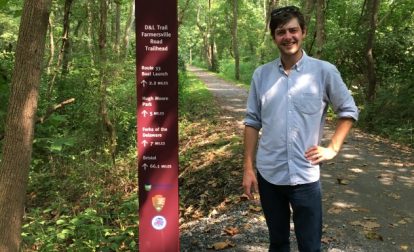
As you read this, a GIS specialist from the National Park Service’s Cultural Resources Geographic Information System Facility is walking the towpath of the Lehigh Canal-GPS receiver in hand-gathering spatial data on all extant historical canal infrastructure.Have you seen this man?  Good, because he is documenting the historic remains of the Lehigh Canal!

In 1982, a company named Environmental Systems Research Institute (ESRI) launched ArcInfo, a personal computer software product primarily used to manage land use and demographic data. The program had a visual representation component of polygons, lines, and points that was linked to a database management tool. Many consider ArcInfo to be the first commercial Geographic Information System (GIS), defined by the National Science Foundation, as “a computer-based system for capture, storage, retrieval, analysis and display of spatial (locationally defined) data.”The GPS satellite constellation has made it much easier to create and customize data for GIS.

Since that first GIS over 25 years ago, the technology and its applications have drastically evolved so that few industries-from planning and government to marketing and public health-can now function without it. The improved accuracy of hand-held Global Positioning System (GPS) receivers has also made the acquisition of customized field data much easier. Users can gather the coordinates of any real-world feature and express it in relation to other geographic layers and sets of data.

Recently, the use of GIS has even extended into historical studies. Preservationists use GIS to create maps of historic districts and protected buildings. Archaeologists express their sites in GIS. Urban historians use it to express demographic change, the city building process, and immigration. A new book on the environmental history of Manhattan (Mannahatta by Eric Sanderson) even uses GIS to make predications about the pre-European ecology of the island.Manhatta pushes the boundaries of historical GIS to another level.

Beginning in 1989, the National Park Service also incorporated GIS into their documentation and conservation projects, especially through the work of the Cultural Resource Geographic Information System Facility (CRGIS). The CRGIS promotes the use of GIS in historic preservation and, to that end, participates in and manages a number of projects each year. The projects range from landscape and cemetery inventories to battlefield and building documentation. The systems created by CRGIS have a number of applications from simple site management to historical interpretation of change over time.CRGIS created a GIS to manage and interpret Alexandria National Cemetery.

This summer, the D&L was fortunate to secure a contract with CRGIS to conduct a GIS inventory of historic Lehigh Canal infrastructure. Specialists will work in the field for a total of two weeks, collecting GPS coordinates for historic remnants. Back in the office, they’ll use the field data to create map layers that can be combined with other layers (historic districts, congressional districts, municipalities, park land, etc.) that will help the D&L manage the remaining canal resources and plan for their protection. A final phase of the contract will include GIS training for D&L staff and the provision of GIS-capable hardware so that we can take full advantage of the completed database and mapping. The use of GIS will also streamline some of our other planning, mapping, and trail development activities.This sample GIS includes all of Lehigh and Northampton counties' parks.

One specialist braved the week’s rain to get several days of GPS inventory recorded.  Expect to see others in the field later this summer and probably through the fall.  Check back for updates about what they find!

Hiking (and fishing) Hickory Run State Park

Tuesday, May 12th, 2009

On Sunday, I decided to walk off a lingering cold by heading north to Hickory Run State Park. Over the last year or so, I have become familiar with linear Lehigh Gorge State Park, through which the D&L Trail passes. Hickory Run abuts Lehigh Gorge but stretches away from the river to include a varied terrain of steep, laurel-blanketed slopes, hardwood forests, pristine mountain streams, and remote swamps. I had passed through Hickory Run several times, stopping at the park office (primarily to use the port-o-potty) but never venturing down the park’s many enticing trails.A downloadable map of Hickory Run State Park is available from the park's website.

When I arrived at the park from the Northeast Extension of the turnpike, I still had no idea which trail or stream I wanted to spend the day following. I slowly drove east on Rt. 534, pulling over at trailheads to consult my map of the park (available on the park’s website). I personally prefer the less-frequented trails and more secluded areas, so I was attracted to Mud Run Natural Area, on the southeastern end of the park. In 1996, over 1,300 acres surrounding Mud Run were set aside as a state designated “natural area,” meaning that the park management would consciously reduce their intervention in that area to limit evidence of a human presence. To that end, only two short trails–Hawk Falls and Orchard Loop–and a primitive access road penetrate the area, and there is no park infrastructure at all south of Mud Run. I parked at the Hawk Falls Trailhead and made my way a short distance down a well-maintained trail to the confluence of Hawk Run and Mud Run. The water was high and fast moving but clear. I noted a sign and trail marker for Orchard Loop that seemed to head uphill, but I decided to follow an unmarked footpath at the edge of the stream and head east.Mud Run is a pristine mountain stream with a viable native brook trout population.

Following the stream was a blessing and curse. The footpath soon revealed itself as a herd path that intermittently died out and resurfaced amid the towering laurel and hemlock. The bank steepened drastically, until I was clinging to trees and side stepping to keep from sliding ten or fifteen feet down into the run. Water from upslope springs dripped down the rock faces and ran in small streams, causing the earth to give way under my feet. Dirt-spattered and scratched, I made my way down to a flat spot on the stream bank, where Mud Run meets with an unnamed tributary and tumbles a few feet down a short series of rapids. I stood watching the pool beneath the rapids, hoping to see a fish dart between the shadows. I had a 4-foot, telescopic pack rod in my backpack, and I decided I would give it a try. On the first cast I pulled out a small brookie, brilliant in color but very small. I tried a few more casts without any luck.A wall of mountain laurel lines Mud Run.

I put away the rod, made my way back onto the slope, and continued the arduous hike forward. After a few hundred yards, the valley opened up below, and I descended to walk along the stream. I reached a section of deep, flat water, downstream from a waterfall of four of five feet. I also noted the yellow trail markings for Orchard Loop, indicating that one could also reach this beautiful spot by much easier means than I had used. I pulled out my rod again, made a few casts into the pool, and saw some small trout following the lure without hitting. A few groups of hikers passed, made small talk, and politely resisted asking why I–sweat and dirt covered–looked like I had been on a jungle safari, when Orchard Loop was a relatively short and flat trail. I fished this section of Mud Run for about an hour and caught only one fish–a fourteen-inch rainbow that was probably the only thing in the stream large enough to go after the monster spinner I had thoughtlessly thrown into my backpack that morning, when preparing for what was supposed to a hike. Next time, I will return with my fly rod.One of Mud Run's deep pools is home to large trout.

Satisfied that I had done some fishing and spent a few hours on this amazing, laurel-framed stream, I located the yellow markers and followed the southern portion of Orchard Loop back towards Hawk Run. I was impressed with the trail work on this section, especially the switchback, complete with stone cribbing and properly functioning water bars. As I had guessed, the trail followed some thirty to forty feet above the steep section I had crawled along a few hours earlier. As much as I now enjoyed the well-maintained path, I broke trail for the last half mile or so to walk through the open forest and between towering walls of mountain laurel. Dozens of painted trillium were in bloom. This time the herd paths benevolently led me across flat ground towards my parked car. When I reached it, I was worn out, as always, but refreshed.Amid mountain laurel and tall hardwoods, trilliums dotted the forest floor.

My short experience in a small corner of Hickory Run State Park left me thoroughly impressed. In my mind, I am already planning my next trip. I encourage you to do the same.

On the D&L Trail: In Lehigh Gap

Tuesday, August 26th, 2008

The D&L Trail follows an abandoned railroad right-of-way for nearly four miles between East Penn Township’s new boat launch and the Lehigh Gap Nature Center. This is a dynamic section of trail, with continuous views of the Lehigh River on one side and the steep, rocky slopes of the Kittatiny Ridge on the other. Air and soil pollution from Palmerton’s zinc smelting plant defoliated the mountainsides, but, with the closing of the plant and the declaration of Lehigh Gap as a Superfund site, a successful remediation project is underway to bring the mountain’s native flora back to life. As you walk or ride the trail, take note of the grasses and shrubs growing among the scattered rocks; these are the first signs of what will one day be a thriving, blanket of green.

Parking is available at the East Penn Boat Launch (on Riverbend Rd., at Lizard Creek Junction) to the north and the Lehigh Gap Nature Center (on Paint Mill Rd., off of Rt. 873) to the south. Over the last year, this section of trail has seen significant improvements. Once the haunt of ATV-riders and the occasional fisherman, the trail has been widened, graded, and rolled so that mountain bikers, joggers, and hikers can also enjoy the trip. In some places, water drainage issues and loose rail ballast need to be addressed, but the trail is in generally good condition and sees regular use.

The scenery is a nice balance of industrial remnants and natural beauty. Along with the piers of old railroad trestles are wetlands and patches of wildflowers. Hawks circle above the river gap, and occasionally through the trees, you will catch a glimpse of the now dormant zinc plant. For a hawk’s-eye view of the gap, use the D&L Trail to access the ridge-running Appalachian Trail at the Nature Center. But, don’t miss the small ponds on the northern section of the trail.

Trail users can choose whether to travel the section and then backtrack or leave a car on both ends. For the more adventurous, continue the journey south along Slatington’s superbly-maintained rail-trail, Walnutport’s scenic canal towpath, or the Slate Heritage Trail that intersects the D&L Trail at Trout Creek.